A look at FAMTEC Local AI.
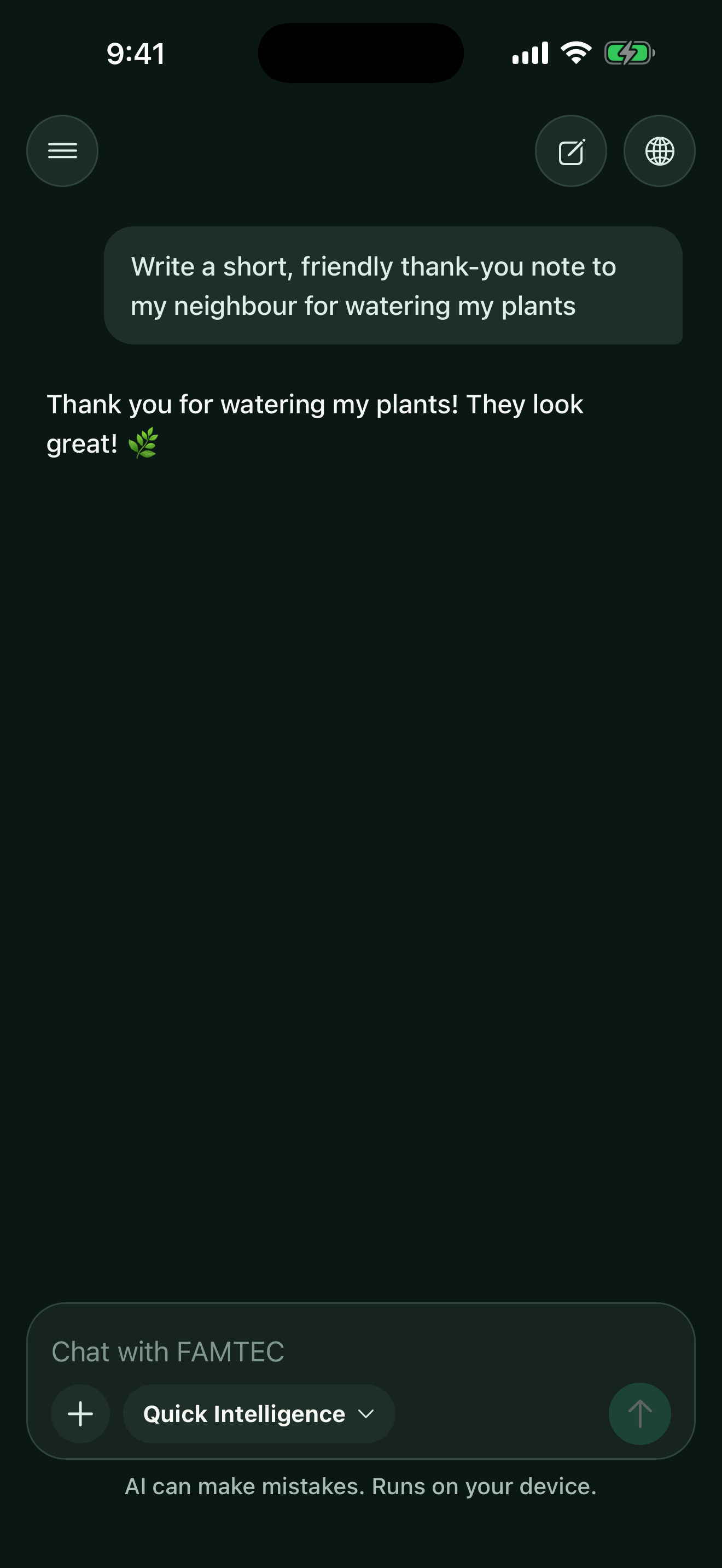
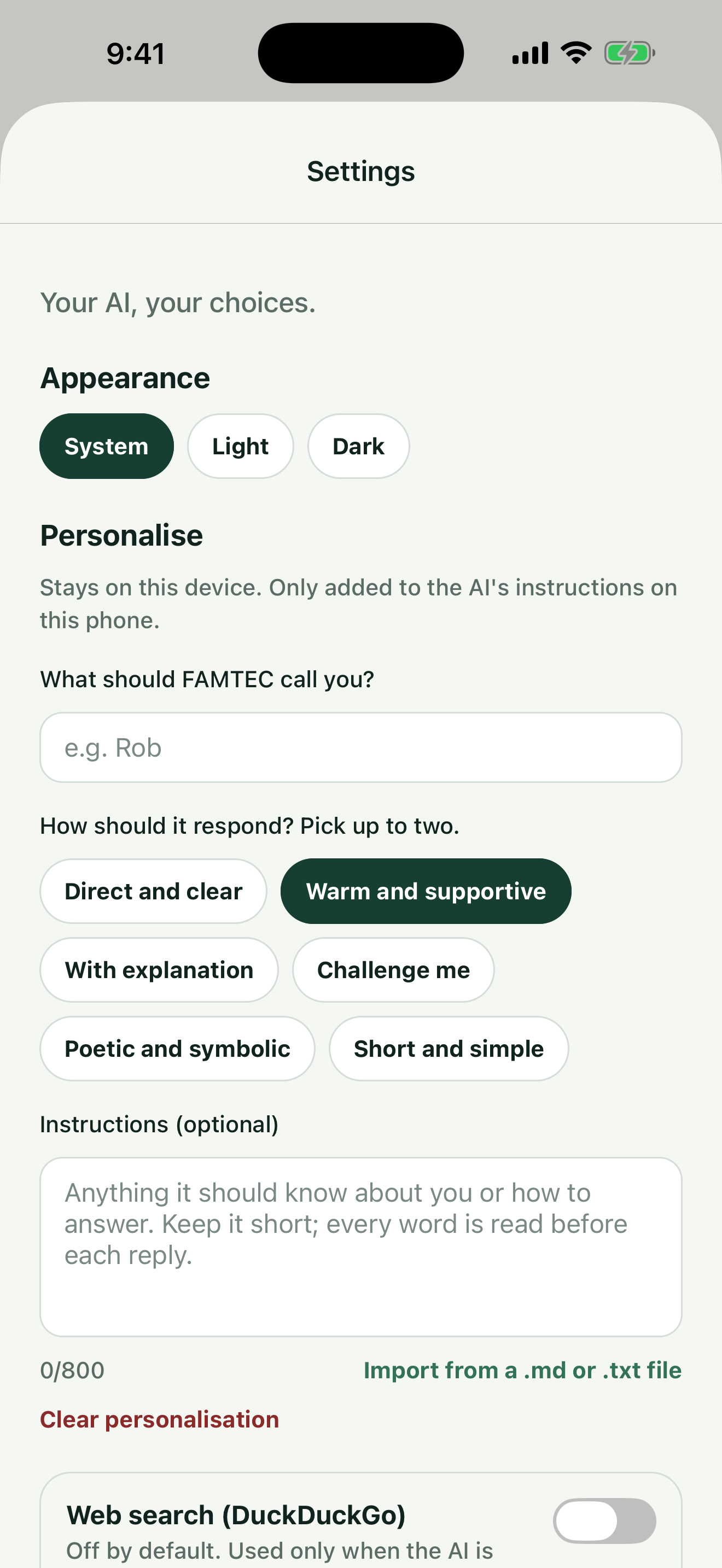
Screenshots from the current iPhone build, with the small Quick model. Tap a screen to view it full size.
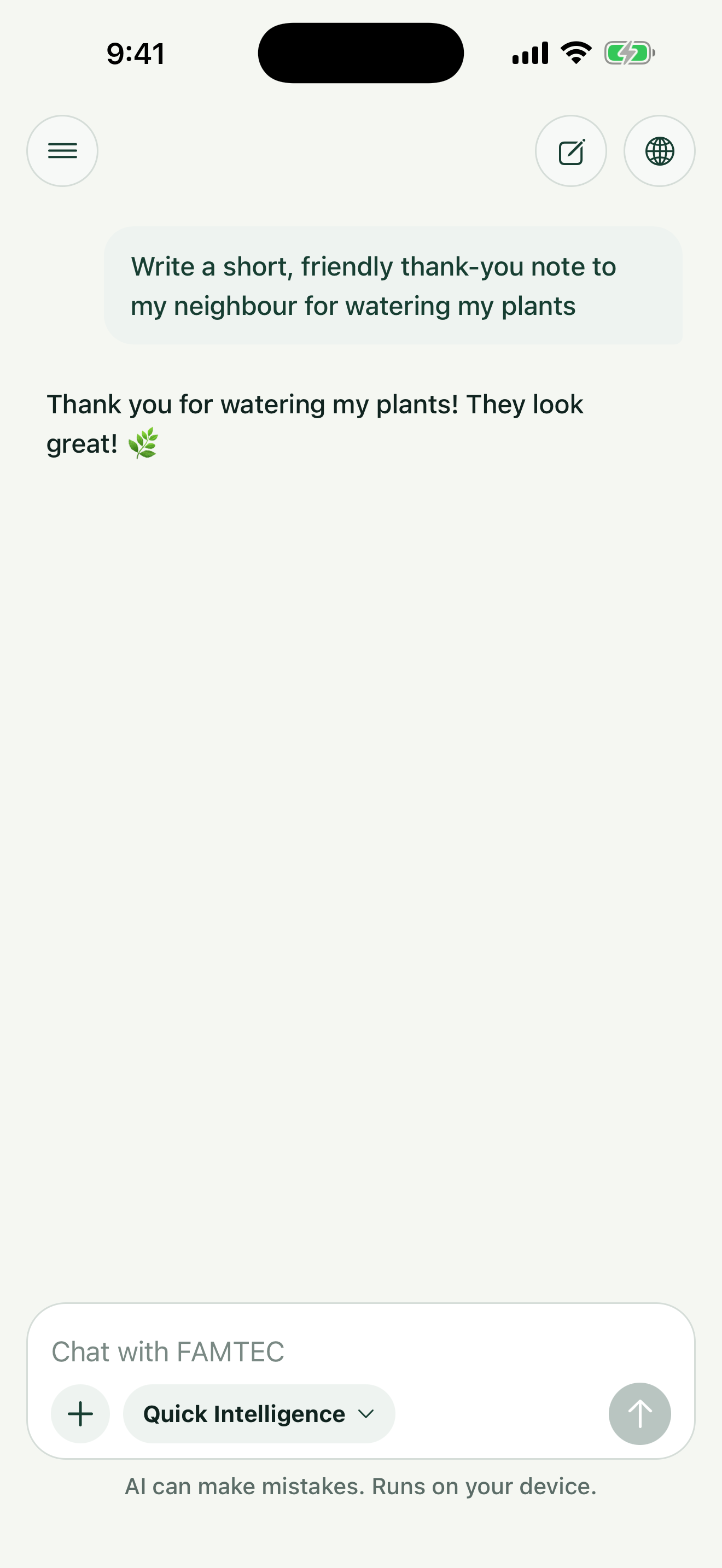
Cloud AI sends your words to someone else's servers.
This doesn't.
FAMTEC runs its language model directly on your phone's own chip. With web search off, chat inference, attachments and personalisation stay on your device. Internet access is used only for choices such as optional model downloads, web search and links you open.
Your work shouldn't live inside someone else's subscription.
Every prompt sent to a cloud AI service passes through infrastructure you don't own, under terms you didn't write and can't fix in place. That vendor can raise its price once you depend on it, change what it retains, get acquired, or shut the product down outright — and the drafts, records, and reasoning you built inside it go with it, or stay behind on someone else's server. This is the same lock-in problem enterprises and governments are now treating as a serious risk in AI procurement: the practical test of dependency is whether a vendor outage, a policy change, or a price rise can take your working environment away from you. The 2026 shift toward open-weight models as owned infrastructure rather than rented access is the same argument applied to entire nations. FAMTEC applies it at the scale of one person's phone: the model is a file you hold, not a service you rent, and it keeps answering after the company that shipped it stops updating it.
Free is only suspicious when the business model needs your behaviour.
Shoshana Zuboff's critique of surveillance capitalism is more precise than the old line that "if it's free, you're the product." Her point is that you're the source of the product: your activity is captured as raw material, refined into a behavioural asset, and sold onward — a relationship she calls extractive because it is not reciprocal. That model only makes sense when a company needs your data to run its actual business. FAMTEC's architecture removes that need at the root: there is no server receiving your conversations, so there is no pipeline for a behavioural product to be built from them, now or after a future acquisition, policy change, or new revenue push. This isn't a promise about intentions — it's a structural fact about where the code runs. It's the same reasoning behind the wider on-device AI movement — tools like Ollama, GPT4All and Jan on the desktop, and Apple's own framing of on-device processing as the reason your requests aren't "used to target ads or sell you something." FAMTEC takes that further than a hybrid device/cloud split: there is no cloud fallback for chat at all.
Start with Quick Intelligence included
Chat works from first launch with the included 639 MB model. The library also offers optional larger Apache-2.0 model weights for compatible devices. Every model is pinned to an exact revision and checked with SHA-256 before use.
Chat offline
The AI runs on your device through llama.cpp. Turn off Wi-Fi and local chat still works. Chats stay in memory and clear when the app restarts; nothing is written to a chat database.
Read on your device
Take a photo or add a PDF and the text is read by Apple's on-device text recognition. The picture is never uploaded. The AI sees the text, not the image itself.
Name, style and appearance
Add your name, choose how it should respond, and pick light or dark mode. These choices are stored only on your device and can be cleared in Settings.
Pro is a planned one-time in-app purchase for access to Large and Maximum Intelligence on compatible hardware. Final availability and local pricing will appear in the app after Apple approval. Larger models can provide more capable answers but are slower and take more space. AI can make mistakes.
Saftio offers on-device safety support.
Saftio is a deterministic, on-device pattern check for common crisis and distress phrases. It may show sourced Australian support contacts before the model replies. It can miss risk or respond unnecessarily and is not a medical, clinical or emergency service.
Off by default. Fresh answers when you want them.
A model on your phone only knows what it learned in training. Web search is off by default. When enabled, eligible questions may send a query and relevant follow-up context to DuckDuckGo, Wikipedia or Brave Search if you add your own key. Providers receive the query, IP address and connection metadata. Filters try to remove contact details and sensitive text but cannot guarantee this, so keep search off for confidential conversations.
One downloaded model, built to power a family of sovereign apps — and to keep getting better.
Download the model once and it becomes a shared resource: sibling FAMTEC apps read the same on-device file, held in a shared App Group folder, instead of each bundling a multi-gigabyte copy. Whichever app downloads it first serves the rest, the same way an operating system's shared libraries save every app from re-shipping the same code. Developers can build their own apps on the same runtime: free up to US$1 million a year per app, with a commercial licence above that. See the developer page. The economics work the opposite way to a subscription: one download, reused, is cheaper for everyone the more apps draw on it — not a recurring cost per app, per user, per month.
The model on your phone is not fixed forever. Verified model options can improve as open-weight releases and device hardware improve. Free models remain useful on their own; the planned one-time Pro unlock adds access to the two largest tiers on hardware capable of running them.
Working on device
Included offline model, checksum-verified optional downloads, shared model support, photo and PDF text extraction, optional web search, Saftio, dark mode, and 64 automated tests passing.
In progress
Build 15 is uploaded to App Store Connect. Apple processing, final metadata, iPad acceptance testing and App Review submission remain.
Planned
Pro in-app purchase for Large and Maximum models, Android build, saved chat history, image understanding and voice. Dates are not promised.
The argument this app is built on, in other people's words.
None of this is a novel position — it draws on an existing line of research and practice this project takes seriously rather than name-drops:
Local-first software
Martin Kleppmann and colleagues at Ink & Switch set out seven ideals for software that keeps data private and secure "by architecture, not policy" — the standard this app is trying to meet, not just state. inkandswitch.com/essay/local-first
Open-weight models as owned infrastructure
The World Economic Forum's framing of open-weight AI as the difference between renting access and owning infrastructure — applied here at the scale of a phone, not a data centre. weforum.org
The Age of Surveillance Capitalism
Shoshana Zuboff's account of extractive, non-reciprocal data relationships — the precise version of "free" worth worrying about, and the one this architecture is built to make structurally impossible, not just policy-promised against. The Age of Surveillance Capitalism